Global dividends reached a third-quarter record of US$546.0 billion in 2026, rising 7.5% from a year earlier on a core basis, a new report finds.
Core growth, which adjusts for exchange rates, special dividends, and other technical factors, was 7.0% for the first nine months of the year, according to the latest Dividend Watch, part of Capital Group’s Global Equity Study.
Of the companies in the Capital Group index, 88% either increased their dividends or held them steady, while median dividend growth reached 5.9%, demonstrating that the improvement was broad-based rather than driven by a small number of very large firms.
Headline growth was more modest at 4.9%, reflecting the negative impact of currency movements and one-off special dividends that were almost US$7 billion lower than a year earlier.
The stronger-than-expected third quarter has prompted Capital Group to upgrade its 2026 global dividend forecast to US$2.24 trillion, with both headline and core growth now expected at 6.8%, up from 6.4% and 6.0% respectively three months ago.
The Q4 outlook has also improved, supported by resilient earnings and strong cash generation across financials, mining and technology.
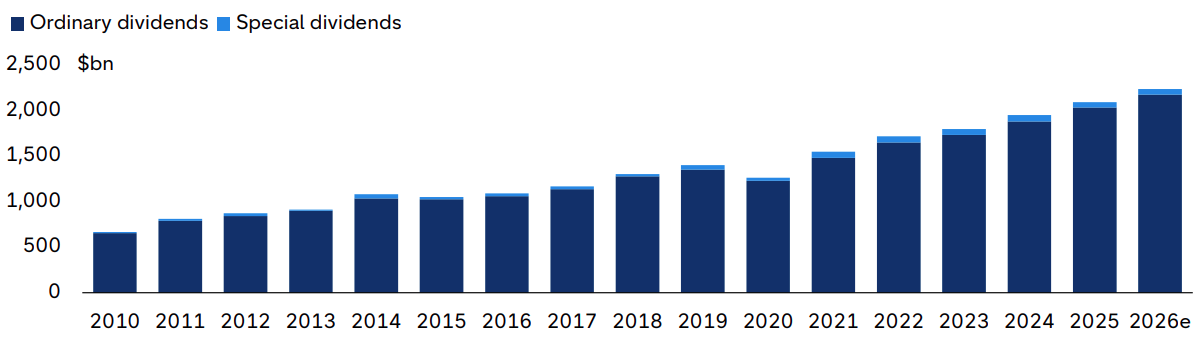
Source: Capital Group Global Equity Study: Dividend Watch Edition Q3 2026 report
Alexandra Haggard, head of product, Europe and Asia-Pacific, at Capital Group, says there are few signs of a meaningful near-term slowdown. Artificial intelligence ( AI ) remains an important driver of growth, and its impact is increasingly extending beyond the technology sector.
“The resulting investment cycle is fuelling demand across the wider industrial economy, while the improving profitability across materials, financials, industrials and parts of healthcare is providing a broader base for dividend growth,” Haggard says.
“Risks remain, including elevated energy costs, trade tensions and divergent monetary policy, but the underlying backdrop remains healthy, supported by strong cash generation and generally robust balance sheets.”
Sector trends
Financials were the biggest contributor to global dividend growth, accounting for one-third of the increase. Banks raised payouts broadly in line with the market, while general financials grew 17.6%, supported by strong capital markets, trading activity and fee income.
Mining and chemicals recorded the fastest growth, with payouts up 21.7%. Mining accounted for around one-sixth of the global increase, as stronger commodity prices and improved cash generation supported higher payouts. Technology contributed another one-sixth of the increase, led by Asian companies.
Oil companies were more restrained despite elevated energy prices. The majors continued to favour buybacks as a more flexible way to return surplus cash, rather than raising ordinary dividends rapidly in response to volatile oil markets.
Regional trends
The geographical picture was mixed but positive. The United States delivered core growth of 5.8%, with 96% of companies maintaining or increasing their payouts. The United Kingdom was one of the strongest major markets, with core growth of 13.2%, as recovering mining profits and stronger bank distributions boosted payouts. Australia also benefited from the mining recovery, while China lagged the global average.
Asia-Pacific was particularly strong, with core growth of 13.3%. Australia and Taiwan accounted for 82% of the regional increase, with mining driving Australia and technology driving Taiwan.
Taiwan was the only major market in the index to set a new Q3 record. Elsewhere, Singapore benefited from strong bank distributions and Korea from banks and industrials.
Europe produced solid growth, although Q3 is a relatively quiet dividend season, making individual large payments unusually influential.
Hong Kong and China
Hong Kong and China posted combined core dividend growth of 5.5% during the quarter, with total payouts reaching US$83.7 billion. Hong Kong outpaced the regional average by scoring a core growth of 6.9%, paying a total of US$9.4 billion in distributions, as higher payouts from HKEX and major financial institutions demonstrated sectoral strength. In contrast, the real estate sector faced continued pressure from elevated borrowing costs and subdued market activity, making it the weakest among major sectors. Dividend growth for the market remained healthy though concentrated among a relatively small number of large companies.
In China, 66% of Chinese companies increased their dividends or held them steady, a much lower proportion than in many developed markets, while median growth was 5.4%. Chemicals and mining contributed almost a quarter of the increase, while financials accounted for around one-third. Dividend growth in China remained uneven, with payouts closely linked to earnings performance and formal payout policies, resulting in greater variation between companies and sectors.
Singapore
Singapore dividends reached US$7.6 billion in the quarter, up 2.5% from a year ago on a topline basis. Core dividend growth was strong at 9.6%, driven by the banking sector, which continued to generate strong profits despite some pressure from lower interest rates. Record fee and non-interest income, alongside strong wealth management and trading revenues, supported higher local bank distributions. Overall, headline growth lagged core growth as special dividends were lower in the same period last year.


